Why Is My Hot Water Not Hot Enough? Your Tempering Valve Could Be the Problem
If your hot water is getting warm but never seems to get properly hot, the problem may not be your hot water system itself.
A faulty or ageing tempering valve can mix too much cold water into the hot water supply, leaving your shower or bathroom taps lukewarm even when the hot water heater is working correctly.
It is a common hot water problem that can sometimes be mistaken for a faulty hot water unit.
What Is a Hot Water Tempering Valve?
A tempering valve is a safety device installed on the hot water pipework.
Its job is simple: it takes very hot water coming from the hot water system and mixes it with cold water before sending it to certain taps inside your home.
For most residential personal-hygiene outlets in Australia, such as showers, baths and bathroom basins, the delivered hot water temperature must generally be limited to a maximum of 50°C.
This is primarily to reduce the risk of serious scalding.
The tempering valve therefore has three connections:
Hot water in + cold water in = tempered hot water out.
So although the water inside a storage hot water system may be around 60°C or hotter, the water reaching your shower can be limited to around 50°C.
Why Is Hot Water Stored at 60°C but Delivered at 50°C?
This can seem contradictory.
If 50°C is considered safer at the tap, why heat the water above 60°C in the first place?
There are two different safety issues involved.
Stored hot water needs to be kept sufficiently hot to help control bacteria such as Legionella. However, water at these temperatures can cause serious burns very quickly.
The solution is to store the water hot and then reduce its temperature before it reaches outlets used for personal hygiene.
That is where the tempering valve comes in.
Hot water system: approximately 60°C or higher where required.
Tempering valve: mixes hot and cold water.
Bathroom outlet: limited to no more than 50°C in a typical residential application.
Some higher-risk facilities, such as aged-care, health-care and certain facilities used by children, have lower maximum delivery temperatures.
Can a Tempering Valve Make My Hot Water Not Hot Enough?
Yes.
This is one of the first things worth checking when a customer tells us:
“My hot water works, but it just isn't hot enough.”
Inside the tempering valve is a temperature-sensitive mechanism that continuously adjusts how much hot and cold water is mixed together.
As the valve ages, becomes contaminated with debris or develops an internal fault, it may begin allowing too much cold water into the mixture.
Instead of delivering water close to its intended temperature, the valve might only deliver lukewarm water.
For example, the hot water entering the valve may be over 60°C while the water leaving the valve is only 40°C.
In that situation, replacing the hot water system would not solve the problem. The hot water system may be heating perfectly well — the problem is occurring after the water leaves the heater.
Signs Your Tempering Valve May Be Faulty
A tempering valve should be considered if you notice:
Your shower gets warm but never properly hot.
Hot water throughout several bathroom outlets is colder than it used to be.
The water temperature fluctuates unexpectedly.
The hot water system appears to be heating normally, but the water reaching the house is lukewarm.
Hot water pressure or flow has reduced.
The problem has gradually become worse over time.
The tempering valve is several years old.
Your kitchen hot water is noticeably hotter than your bathroom hot water.
That last point can be particularly useful when diagnosing a problem.
In some plumbing installations, the kitchen may receive hotter water while bathrooms are supplied through a tempering valve. If the kitchen water is hot but the shower and bathroom basin are only lukewarm, the tempering valve becomes one of the components worth investigating.
It does not automatically mean the valve is faulty, but it is a useful diagnostic clue.
What Causes a Tempering Valve to Fail?
Tempering valves are mechanical devices working continuously in a hot water environment.
Over time, several things can affect their operation.
The internal temperature-sensitive element can deteriorate. Strainers can become partially blocked by debris. Mineral deposits or scale can interfere with moving components. Non-return valves can become restricted or fail to operate correctly.
Changes in water pressure or temperature can also affect the valve's performance.
Sometimes a valve simply reaches the end of its useful service life.
This is why a plumber should test the temperature of the water before and after the tempering valve rather than automatically assuming the hot water system needs replacing.
How Long Does a Tempering Valve Last?
A useful rule of thumb is around five years, although there is no exact age at which every tempering valve will suddenly fail.
Some valves last longer, while others can develop problems earlier depending on water quality, usage, installation conditions and maintenance.
Some tempering valve manufacturers recommend replacement after approximately five years of service as a safety measure.
If your tempering valve is five years old or older and your hot water has gradually become cooler or inconsistent, the valve is certainly worth checking.
Age alone does not prove that the valve is faulty, but it becomes an increasingly likely possibility.
Is My Tempering Valve Faulty or Is My Hot Water System Faulty?
The symptoms can sometimes help narrow it down.
What you are experiencing Possible cause Water is consistently lukewarm throughout the bathroomsTempering valve, thermostat or heating problem No hot water at all Power, gas, element, thermostat, ignition or hot water system fault Water starts hot but quickly runs cold Hot water capacity, heating or recovery problem Only one shower or tap has the problem Mixer, cartridge or fixture problem Kitchen is hot but bathrooms are lukewarmTempering valve or tempered-water supply issue Water temperature constantly changes Tempering valve, pressure, flow or hot water system issue
These are only diagnostic clues. The temperatures and operation of the system need to be tested before the cause can be confirmed.
Can a Tempering Valve Be Adjusted?
Tempering valves can be commissioned and adjusted to achieve the required delivery temperature, but simply turning the valve up is not always the answer.
If an older valve has begun failing internally, adjusting it may provide little or no improvement.
More importantly, the valve is a hot water safety device. Incorrect adjustment can result in excessively hot water being delivered to showers, baths and basins, creating a serious scalding risk.
Tempering valve adjustment, testing or replacement should therefore be carried out by a licensed plumber who can measure the actual water temperature and ensure the installation remains compliant.
Why Doesn't My Shower Feel Very Hot at 50°C?
People sometimes expect hot water from a newly installed system to feel as hot as water from an older installation.
A correctly operating temperature-control system may make the difference noticeable.
The tempering valve limits the maximum temperature supplied to personal-hygiene fixtures. There can then be additional heat loss as the water travels through the pipework between the hot water system and the shower.
Long pipe runs, cold weather and poorly insulated hot water pipes can make the temperature at the outlet slightly lower again.
However, if your shower has suddenly become much cooler than it used to be, that is different and should be investigated.
Does Every Hot Water System Have a Tempering Valve?
Not necessarily.
The exact temperature-control arrangement depends on the hot water system, when it was installed, the building and how the plumbing has been configured.
Some hot water systems can limit their own outlet temperature and may not require a separate tempering valve in the same way as a conventional storage system.
Other installations use a tempering valve or a thermostatic mixing valve.
In Victoria, temperature-control requirements also depend on the type of installation and whether an existing hot water service is being installed, replaced or altered.
For homeowners, the important point is that water supplied to fixtures used for personal hygiene needs appropriate temperature control.
Where Is the Tempering Valve Located?
On many residential storage hot water systems, the tempering valve can be found in the pipework close to the hot water unit.
It is generally a small valve with three pipe connections:
HOT, COLD and MIXED/OUT.
The exact appearance and location varies between installations.
If you are unsure which valve is the tempering valve, avoid adjusting valves around the hot water system yourself. Some are important safety and pressure-control devices.
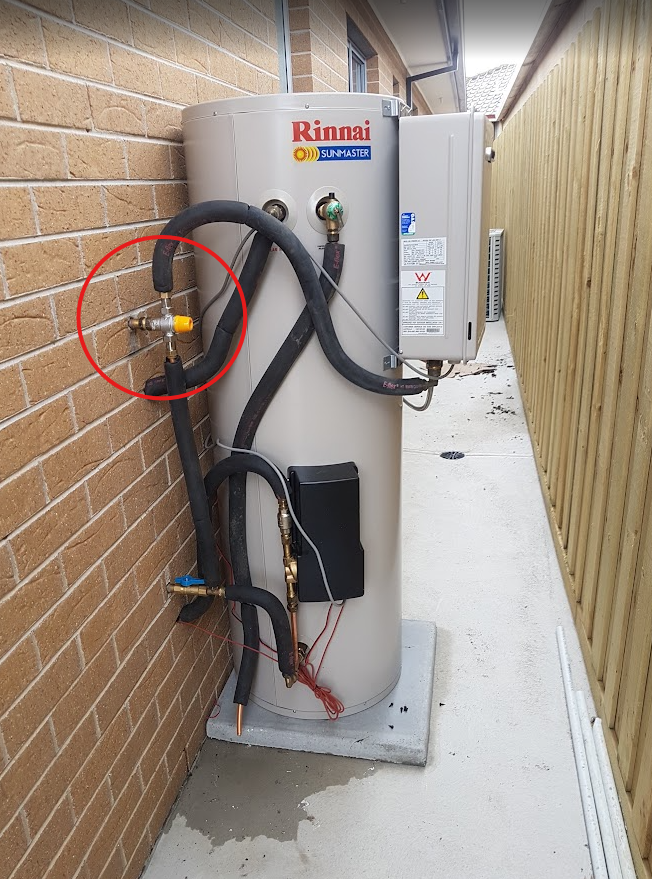
Temp Valve in Red Circle
What Should I Do If My Hot Water Is Only Lukewarm?
If your hot water is no longer as hot as it used to be, don't automatically assume you need a new hot water system.
A plumber can test:
the temperature being produced by the hot water system, the temperature entering the tempering valve, the temperature leaving the valve, hot and cold water pressures, flow through the valve and the final temperature at your taps.
This makes it possible to determine whether the problem is the hot water heater, tempering valve or another part of the plumbing system.
A relatively small valve problem can otherwise look very similar to a failing hot water system.
Frequently Asked Questions
Why is my hot water warm but not hot?
If your hot water is only lukewarm, possible causes include a faulty tempering valve, thermostat problem, heating element fault, gas burner issue or a problem with the hot water system itself. If the heater is producing hot water but the water becomes cooler after passing through the tempering valve, the valve may be mixing in too much cold water.
Can a faulty tempering valve cause lukewarm water?
Yes. A faulty tempering valve can allow too much cold water to mix with the hot water, resulting in lukewarm water at showers and taps.
What temperature should a tempering valve be set to?
For a typical residential installation, heated water supplied to outlets used for personal hygiene must generally not exceed 50°C. Some higher-risk facilities have a maximum delivery temperature of 45°C.
How long does a hot water tempering valve last?
Around five years is a useful guide. Some valves last longer and some fail earlier. Water quality, usage, installation conditions and maintenance all affect service life.
Does a tempering valve reduce hot water temperature?
Yes — that is its purpose. It mixes cold water with the hotter water coming from the hot water system so that the water supplied to personal-hygiene fixtures remains at a safer temperature.
Can I remove the tempering valve to make my shower hotter?
A tempering valve should not simply be removed or bypassed to increase water temperature. It forms part of the hot water temperature-control and scald-protection system. If your water is unusually cool, the correct approach is to find out why.
Can a plumber test a tempering valve?
Yes. A plumber can measure the water temperature entering and leaving the valve, check the final outlet temperature and inspect the valve and associated pipework to determine whether it requires adjustment, servicing or replacement.
Hot Water Not Hot Enough in Melbourne?
If your hot water is only lukewarm, has gradually become colder or your shower simply isn't as hot as it used to be, the hot water system itself may not necessarily be the problem.
A faulty tempering valve is one of the components that should be checked before deciding that an entire hot water system needs replacing.
Fox Plumbing & Drainage can test the hot water system and temperature-control valve to identify where the temperature is being lost and determine the appropriate repair.
If you're located in Melbourne's western suburbs and are having problems with your hot water, get in touch to arrange an inspection.